
Quick answer: Wolf Tooth makes eight SPD-compatible clipless pedals and three flat pedals. For gravel, pick the DEL (or the 174g DEL MK0 for racing). For XC, pick the ALT family. For trail and downcountry, pick CTRL. For enduro and downhill on clipless, pick SHIFT. On flats, choose the concave Waveform if you want maximum grip and a locked-in feel, or the convex Ripsaw if you like to move your feet around.
Wolf Tooth's range can look overwhelming at first. Once you know what separates each model, it's simple. This guide breaks down every current Wolf Tooth pedal, what it's built for, and who should ride it.
Wolf Tooth pedals at a glance
Clipless (SPD-compatible) pedals
All weights are manufacturer-claimed, per pair.
| Model | Best for | Weight | Contact area | Q-factor | Construction |
|---|---|---|---|---|---|
| DEL | Gravel | 216g | 559mm² | 51/55/59mm adjustable | CNC aluminium, stainless axle |
| DEL MK0 | Gravel racing | 174g | 559mm² | 51/55/59mm adjustable | CNC aluminium, titanium axle |
| ALT Performance | XC | 326g | 534mm² | 55mm fixed | Forged and post-machined aluminium, chromoly axle |
| ALT | XC | 294g | 443mm² | 51/55/59mm adjustable | CNC aluminium, stainless axle |
| ALT MK0 | XC racing | 246g | 413mm² | 51/55/59mm adjustable | CNC aluminium, titanium axle |
| CTRL Performance | Trail and downcountry | 341g | 965mm² | 55mm fixed | Forged and post-machined aluminium, chromoly axle |
| CTRL | Trail and downcountry | 326g | 941mm² | 51/55/59mm adjustable | CNC aluminium, stainless axle |
| SHIFT | Enduro and downhill | 410g | 1,201mm² | 51/55/59mm adjustable | CNC aluminium, stainless axle |
Flat pedals
| Model | Best for | Weight | Platform | Thickness (edge/centre) | Shape | Axle | Pins |
|---|---|---|---|---|---|---|---|
| Waveform Performance | Excellent grip at a lower price | 384g | 112 x 106mm | 16/13.5mm | Concave | Chromoly steel | 9 per side |
| Waveform Aluminium | Maximum grip | 373g (S)/384g (L) | 105 x 99mm (S)/112 x 106mm (L) | 14/12.5mm | Concave | Stainless steel | 11 per side |
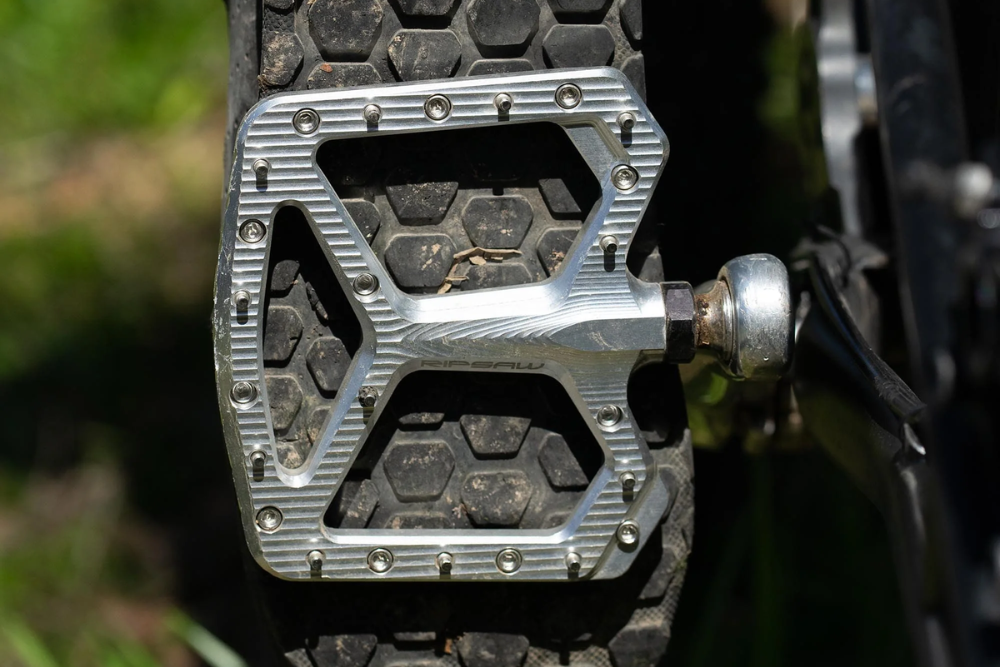
| Ripsaw Aluminium | Maximum versatility | 380g | 118 x 102mm | 7/12.5mm | Convex | Stainless steel | 12 per side |
Which Wolf Tooth Pedal should I buy?
| If you ride... | Choose | Why |
|---|---|---|
| Gravel, adventure or bikepacking | DEL | Thin single-sided body, big contact area, great mud clearance |
| Gravel races | DEL MK0 | The lightest version, at 174g a pair |
| XC on a budget | ALT Performance | Big platform, tough chromoly axle, lower price |
| XC and marathon | ALT | Lighter, with adjustable Q-factor |
| XC races | ALT MK0 | Lightest and thinnest ALT, titanium axle |
| Trail and downcountry | CTRL or CTRL Performance | Nearly 1,000mm² of shoe support without gravity-pedal weight |
| Enduro and downhill, clipped in | SHIFT | Largest platform of any SPD-compatible pedal |
| Trail to freeride on flats, locked in | Waveform Aluminium | Concave shape and 11 pins per side |
| Trail to freeride on flats, lower price | Waveform Performance | Same concave feel, 9 pins per side |
| Trail to freeride on flats, free to move | Ripsaw | Convex shape, just 7mm at the edges |
Clipless vs flat pedals: what's the difference?
Clipless (SPD) pedals lock a cleat on the bottom of your shoe into the pedal. You clip in by stepping down and release by twisting your heel outward. They give the most efficient pedal stroke and keep your feet in the same position over rough ground.
Flat pedals have no mechanism. Steel pins grip a flat-soled shoe instead. They let you put a foot down or bail instantly, and they're popular with trail, enduro and freeride riders and anyone learning technical skills.
Every Wolf Tooth clipless pedal works with standard SPD cleats, and Wolf Tooth cleats with 5° of float and a 12° release angle come in the box.
Key terms explained
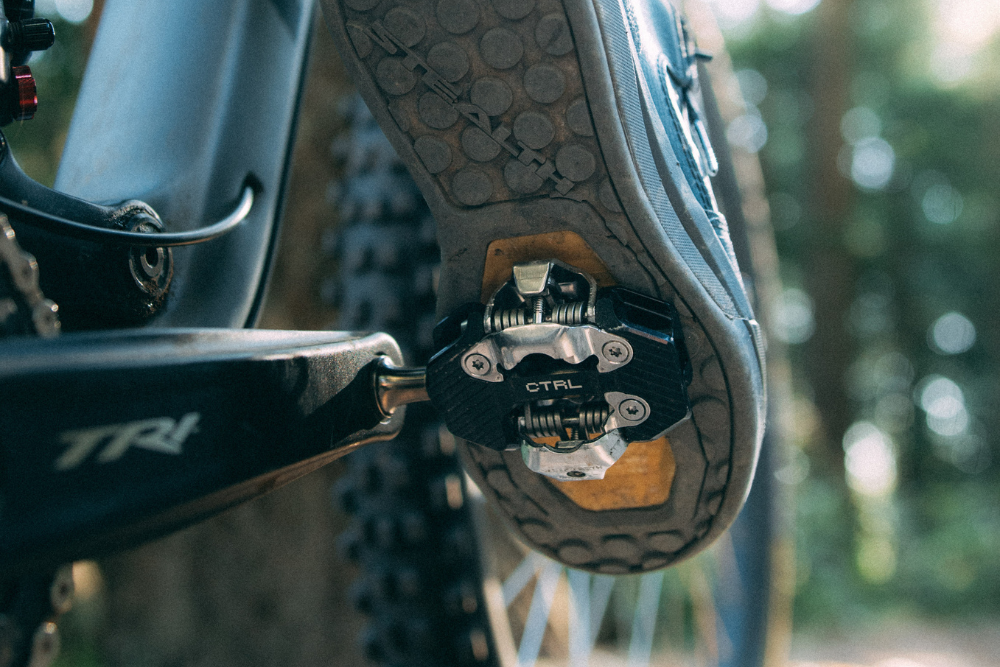
Contact area: the amount of pedal body that touches the sole of your shoe, measured in mm². Most SPD pedals only touch the shoe at the cleat. More contact gives a more stable, supportive feel and better power transfer. This is the big idea behind Wolf Tooth's clipless range.
Q-factor: how far your feet sit from the centre of the bike. Most Wolf Tooth clipless pedals let you change it to 51, 55 or 59mm by rearranging the internal spacers and bearings, a job you can do at home. An optional spacer kit adds 53 and 57mm positions. The two Performance models are fixed at 55mm.
MK0 vs Standard vs Performance: Wolf Tooth sells its pedals in up to three tiers. Performance is the entry point, with a chromoly axle and fixed Q-factor. Standard is CNC-machined in Minnesota with a stainless axle and adjustable Q-factor. MK0 is the lightest, with titanium axles and hardware and extra machining.
DEL: the gravel specialist
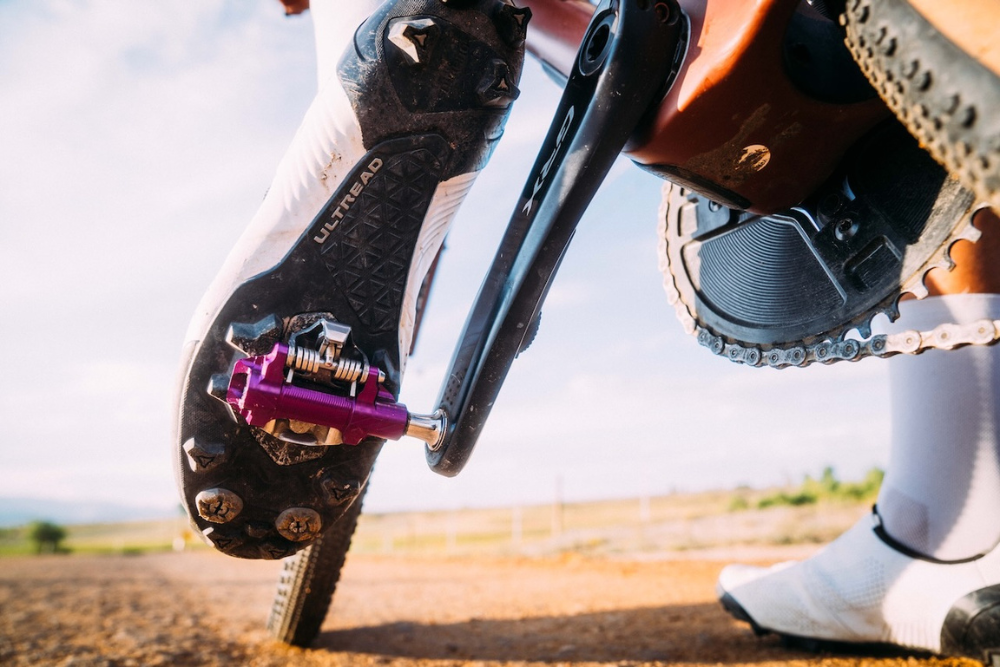
The DEL is built for gravel: fast fire roads, gravel paths, long-distance adventures and gravel racing.
It's a light, thin, single-sided SPD pedal with a large 559mm² contact area. The single-sided design sheds mud well and keeps the pedal body as thin as possible, so you're less likely to clip rocks or roots on rough gravel.
The DEL comes in two versions, the standard DEL and the DEL MK0. Both have adjustable Q-factor and the same contact area.
DEL MK0 is for riders who want the lightest gravel pedal possible. At 174g a pair, Wolf Tooth claims it's the lightest full-featured SPD-compatible pedal available. It gets there with titanium axles and hardware plus extra machining. MK0 pedals have a 90kg maximum rider weight, so heavier riders should choose the standard DEL.
ALT: the XC family
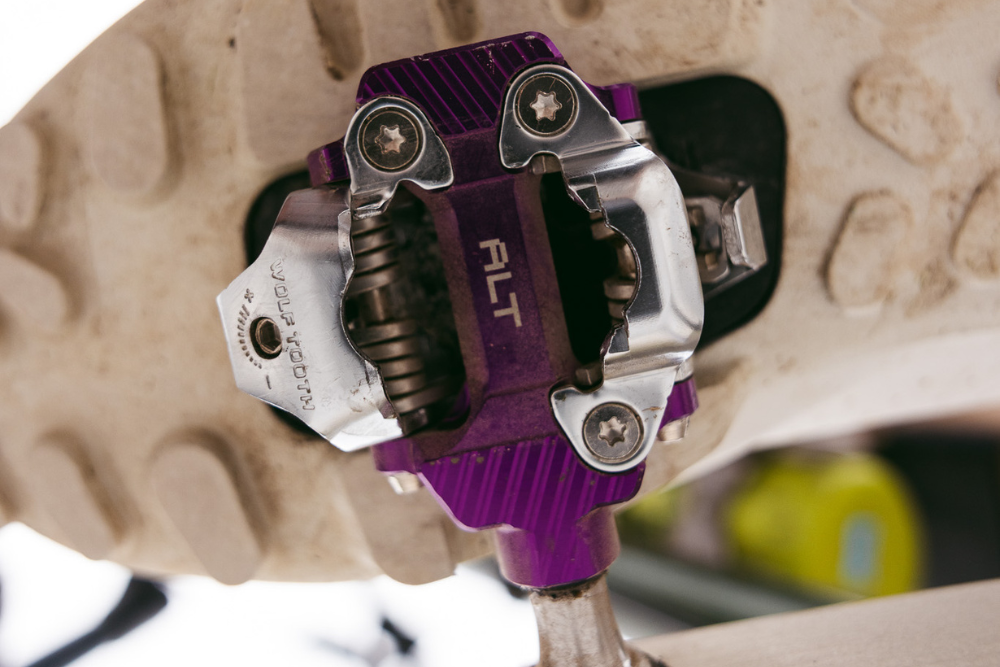
The ALT family is designed for cross-country, downcountry, gravel racing and trail riding. Compared to the DEL, it's a double-sided pedal built for more off-road support and designed to work best with MTB shoes.
Most XC pedals only touch the shoe at the cleat, which can feel like standing on a golf ball. ALT pedals use a broad body so the sole of your shoe sits on the pedal too, which feels much more supportive than a traditional small SPD pedal.
There are three versions of the ALT.
ALT Performance is the entry point. It has the largest contact area of the three (534mm²), a fixed 55mm Q-factor and a tough chromoly axle taken from the Waveform Performance flat pedal. It's a little heavier at 326g, but keeps the same thin 15mm body.
ALT (Standard) sits in the middle. It's 32g lighter than the Performance at 294g a pair, adds adjustable Q-factor and uses a stainless steel axle in the same 15mm body.
ALT MK0 is the race pedal. It has a slightly thinner 14.5mm body, titanium axles and hardware and a slightly smaller 413mm² contact area. At 246g a pair, it's the lightest and thinnest ALT and Wolf Tooth's benchmark XC race pedal. Like all MK0 pedals, it has a 90kg rider weight limit.
CTRL: the trail pedal
If ALT is about going fast uphill and across the course, CTRL is about staying connected when the trail gets rough.
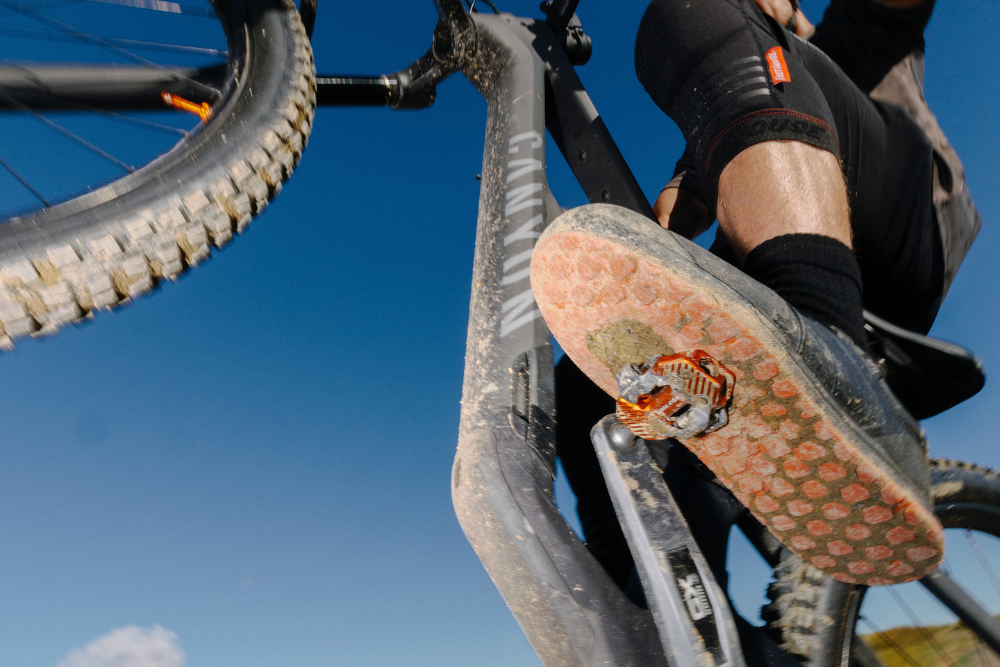
CTRL is Wolf Tooth's trail and downcountry family. Its platform is more than twice the size of the ALT's, so your shoe gets much more support. That extra platform feels more planted when you're riding aggressively, landing jumps or pushing through rough terrain.
There are two versions.
CTRL Performance is the value option for riders who care less about grams or adjustable Q-factor. It has the larger contact area of the two (965mm²), a fixed 55mm Q-factor and a chromoly axle, and weighs 341g a pair.
CTRL (Standard) has a 941mm² contact area, a 15mm thin body, adjustable Q-factor and a stainless steel axle, and weighs 326g a pair.
Either CTRL is a great choice if you want a big platform without going to a full gravity pedal.
SHIFT: the gravity specialist
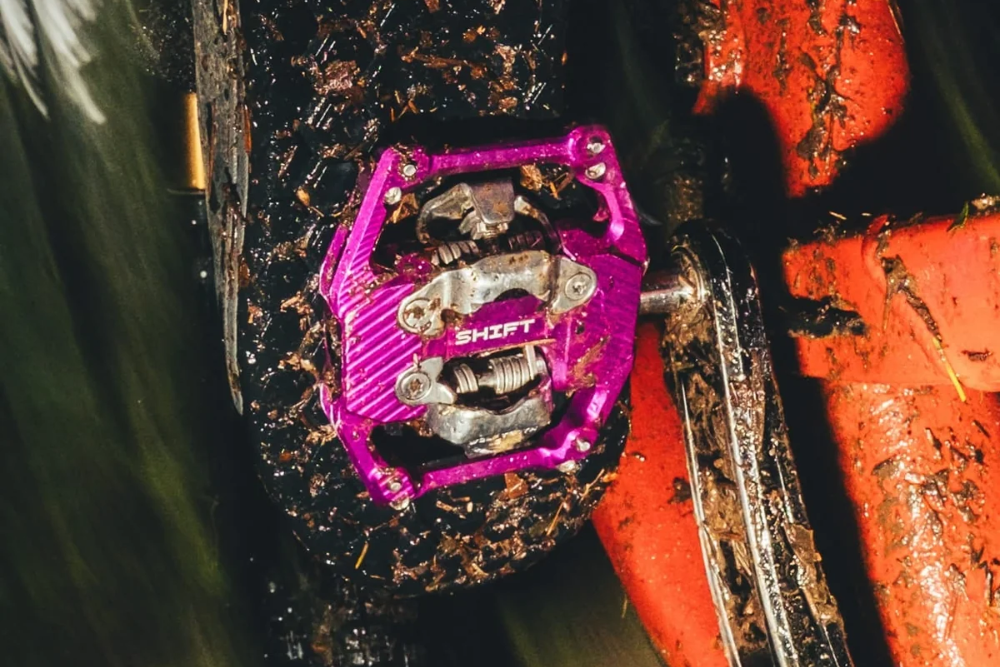
SHIFT is Wolf Tooth's SPD pedal for downhill, enduro and aggressive trail riding, where support and control matter most. It comes in one version.
With a 1,201mm² platform, Wolf Tooth says no other SPD-compatible pedal is as large. Up to eight optional stainless steel pins (four per side) add even more grip if you want it. Wolf Tooth recommends riding without them first and adding pins if you need more traction.
SHIFT also has the adjustable-Q-factor stainless steel axle and a body just 15mm thick, so you get good clearance on DH and enduro features. It weighs 410g a pair.
If you want an SPD-compatible gravity pedal with maximum shoe support, look no further.
Flat pedals: concave vs convex
Flat pedals look simple, but the shape of the platform changes how the bike feels under your feet.
Some riders want their feet locked into a deep, supportive platform. Others prefer a pedal that lets them reposition their feet easily on the trail. Wolf Tooth makes both.
There are three Wolf Tooth flat pedals: Waveform Performance, Waveform Aluminium and Ripsaw Aluminium. All three suit trail riding through to enduro and freeride, but they use two different platform shapes:
- Waveform is concave, designed for maximum grip.
- Ripsaw is convex, designed for maximum versatility.
Waveform: maximum grip
Waveform has a concave platform. The sole of your shoe is cradled between the raised edges and pins, so your foot stays in one spot and feels very planted.
The Waveform Performance and the large Waveform Aluminium share the same 384g weight and 112 x 106mm platform. They differ in construction and pin count.
Waveform Performance is the more affordable option. It's slightly thicker at 16mm, with a chromoly steel axle, an extruded and post-machined body and 9 steel pins per side (18 total).
Waveform Aluminium is thinner at 14mm, with a stainless steel axle and a fully CNC-machined body. It adds two extra pins per side (11 per side, 22 total) for maximum grip. It comes in two sizes: Large (112 x 106mm, 384g) and Small (105 x 99mm, 373g) for smaller feet.
Both offer excellent grip and come in a range of colours.
Ripsaw: maximum versatility
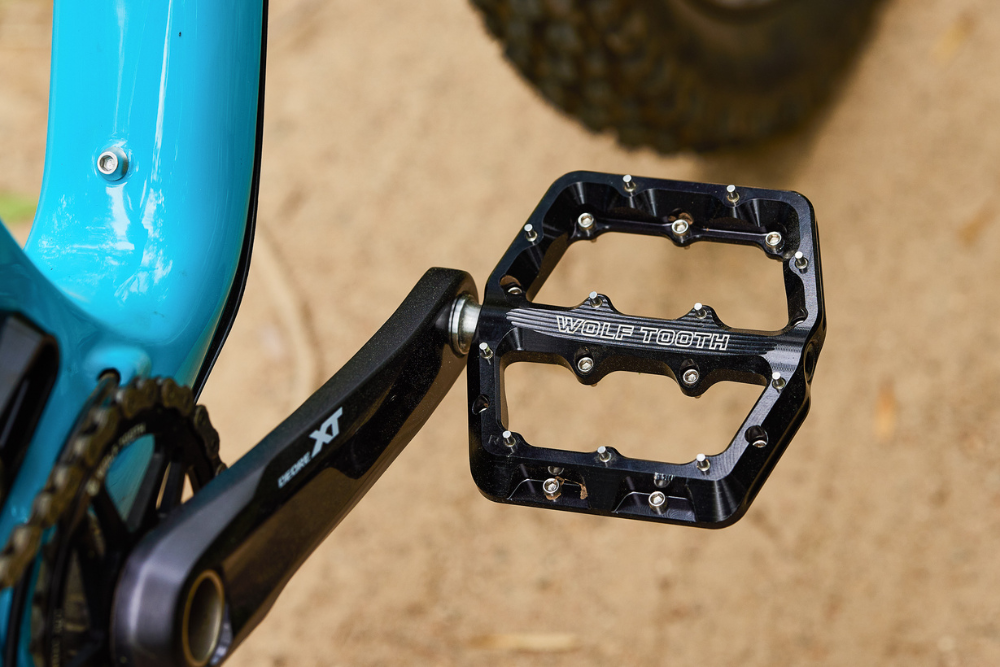
Ripsaw has a convex platform, tallest at the axle and tapering to the edges. The biggest advantage is freedom of movement: you feel less locked in, which suits riders who reposition their feet in corners or on changing terrain. Wolf Tooth designed it for riders who pedal mid-foot, with the arch of the foot over the centre of the pedal.
The convex shape also makes the Ripsaw just 7mm thick at the front and rear edges (12.5mm in the centre), which helps with clearance on rocky, technical trails.
Ripsaw weighs 380g, has a large 118 x 102mm platform, 12 stainless steel pins per side (24 total), a stainless steel axle and a fully CNC-machined body.
Which Wolf Tooth flat pedal is best?
There's no single best flat pedal. It depends on how you like your feet to feel.
- Want a locked-in feel? Get the Waveform Aluminium. It also comes in a Small size for smaller feet.
- Want that feel for less? The Waveform Performance has slightly fewer pins but still grips very well.
- Like to move your feet around? The Ripsaw gives a more traditional flat-pedal feel and lets you reposition easily.
Frequently asked questions
Are Wolf Tooth pedals compatible with Shimano SPD cleats?
Yes. Every Wolf Tooth clipless pedal (DEL, ALT, CTRL and SHIFT) works with standard Shimano SPD cleats. Wolf Tooth's own cleats, with 5° float and a 12° release angle, come in the box.
What is the lightest Wolf Tooth pedal?
The DEL MK0, at 174g per pair. Wolf Tooth claims it's the lightest full-featured SPD-compatible pedal available. The lightest double-sided Wolf Tooth pedal is the ALT MK0 at 246g.
What's the difference between Wolf Tooth MK0, Standard and Performance pedals?
Performance is the entry tier, with a chromoly axle and a fixed 55mm Q-factor. Standard pedals are CNC-machined with a stainless axle and adjustable Q-factor. MK0 is the premium tier, with titanium axles and hardware and extra machining for the lowest weight. MK0 pedals have a 90kg maximum rider weight.
What is the difference between the Wolf Tooth DEL and ALT?
The DEL is a single-sided gravel pedal, lighter and with a larger contact area (559mm²). The ALT is double-sided for faster entry on MTB trails and XC courses, with a body designed for MTB shoes.
Which Wolf Tooth pedal is best for trail riding?
For clipless riders, the CTRL or CTRL Performance, with 941 to 965mm² of contact area. For flat-pedal riders, the Waveform for a locked-in feel or the Ripsaw for more freedom to move.
Can I adjust the Q-factor on Wolf Tooth pedals?
Yes, on the DEL, DEL MK0, ALT, ALT MK0, CTRL and SHIFT. You rearrange the internal spacers and bearings to get 51, 55 or 59mm, and an optional spacer kit adds 53 and 57mm. The ALT Performance and CTRL Performance are fixed at 55mm.
Should I choose a concave or convex flat pedal?
Choose concave (Waveform) if you want your foot cradled and held in one position. Choose convex (Ripsaw) if you pedal mid-foot or like to shift your feet around in corners and on technical terrain.
Shop the full Wolf Tooth pedal range at Pushys.